
The piano is an intoxicating instrument. Those who have played in their youth often harbour a desire to return to it later in life. Piano ‘returners’ make up an increasingly large cohort of amateur pianists, and whether younger or older, it’s usually fairly easy to pick up again from where you left off. Progress can be swift and it offers the opportunity to fall in love with this majestic instrument, enjoying it’s colossal repertoire all over again.
About the Series
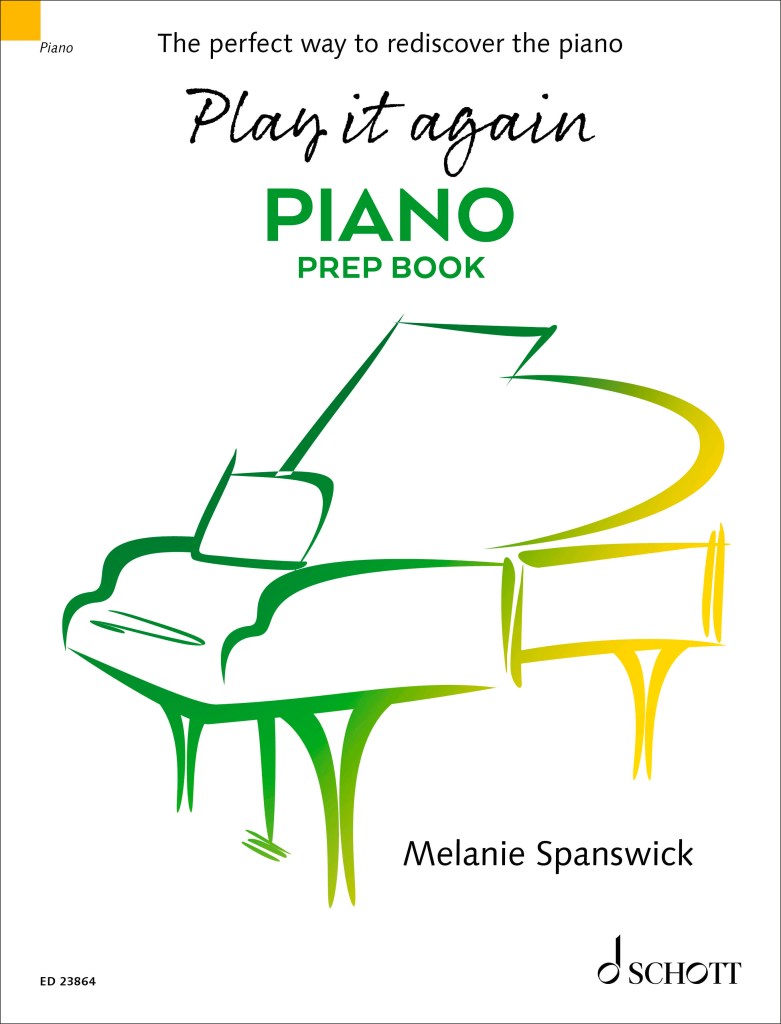
My three-book piano course Play it again: PIANO has been written with the adult ‘returner’ in mind, and a fourth book to go alongside this already popular series has just been published. The Prep Book, published last Thursday, is intended to prepare students for Books 1 – 3 of the series.
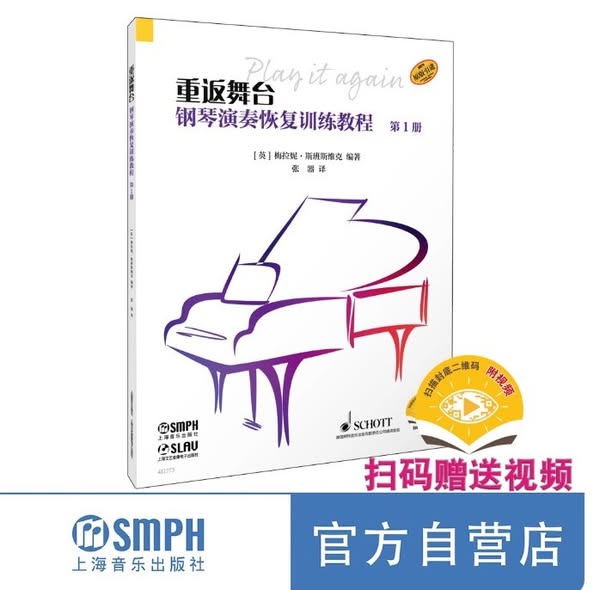
Last month, Books 1 – 3 were published in Chinese by the Shanghai Music Publishing House – a project that had been nearly 5 years in the making – and next year we will start translating the series into German, too.
The entire course currently consists of 97 piano pieces from the Prep Book to Book 3. Many pieces are drawn from the standard repertoire and there is a strong emphasis on pedagogical works. The course now begins at late-beginner level and progresses to advanced (associate diploma) level. Books 1 – 3 has a comprehensive piano ‘technique’ section at the beginning, providing plenty of technical reminders and practice recommendations. There’s a ‘theory’ section at the end of Book 1 and 2, and warm-up exercises at the end of Book 3. Every piano piece is accompanied by at least two or three pages of practice ideas and tips, running to five or six pages in Book 3, and there are also many musical examples, diagrams, and photographs peppering the text throughout.
This is a progressive course therefore it’s possible to ‘return’ to a level to suit your current standard. Some may want to start at the beginning, and I suggest this as it can be highly beneficial, even if you’re playing is at a fairly advanced level. Others may prefer to ‘drop in’ at Book 1 or Book 2 or an even later stage.
The Prep Book
The Prep Book takes pianists almost from the beginning through to Grade 1 of the British music exam board levels, and it has been written for the older learner or ‘returner’ who wants to go back to studying simple repertoire yet still has some memory of what was learned previously.
In the Prep Book you will find plenty of information regarding posture and how to sit at the instrument at the beginning of the book, as well as some useful exercises which aim to help readers become aware of tension in the arms, wrists and hands, and how to alleviate this issue during practice sessions. As the Prep Book is intended for those who haven’t been playing the instrument for very long, attention is focused on reading and reinforcing music notation and the practice of rhythmic exercises (involving lots of tapping and clapping!) both at the beginning – and the end – of the volume.
There are three levels containing 37 pieces in total: Late-Beginner, Preparatory, and Early Elementary. Late-Beginner and Preparatory both contain 13 pieces and Early Elementary contains 11. Although this course is not necessarily exam-based, it’s useful to know the approximate level for each section.
Late-Beginner starts with many pieces for separate hands only or hands ‘interweaving’ throughout a piece. It might be considered as a similar level to the end of a book 1, or beginning of book 2, of a piano method series. Hands often remain in the five-finger position at this stage. As this is a course for teenagers and adults, I’ve made sure that the pieces are not too short as is common in many beginner method books which have been written for children, and if they are only a few bars in length, I’ve coupled them with another piece on the same page. It’s my experience that adults want to play slightly more substantial pieces.
Moving to Preparatory level, the hands are now playing together, and they start to move out of the five-finger hand position. New keys are introduced as is simple pedalling. In Early Elementary, pieces are roughly equivalent to those of Grade 1 of the British music examination board standards. One of the joys of writing books for adult pianists is that I’ve not had to worry too much about including music suitable for small hands and little fingers only, and therefore some of the pieces do encompass larger intervallic movement such as an octave.
Each section contains at least one ‘study’ or exercise, two or three famous arrangements as well as a mixture of historical pieces. In this volume I have sought to add some less-popular composers as well as the usual favourites, and there are new commissions from two female educational composers: British composer Rosa Conrad and Chinese composer, Hong Kong-based Sharon Choi. Here’s the content list:
Prep Book Repertoire
Late-Beginner
Ave, Generosa by Hildegard of Bingen, arr. Melanie Spanswick
Study in C from Kinder-Klavierschule by Heinrich Wohlfahrt
Can Can by Jacques Offenbach, arr. Melanie Spanswick
Little Melodic Studies for Beginners Op. 187 No. 13 and 14 by Cornelius Gurlitt
Cradle Song Op. 49 No. 4 by Johannes Brahms, arr. Melanie Spanswick
Song and Ukrainian Folk Song by Leonid Vladimirovich Nikolayev
Cherries and Little Mazurka by Milada Borová and Zdena Janzurová
Sparkle by Melanie Spanswick
Ripples by Rosa Conrad
Scarborough Fair Trad. arr. Melanie Spanswick
Preparatory
Old German Dance by Michael Praetorius
Andante and Allegro moderato from 120 Pieces for Aspiring Beginners by Daniel Gottlob Türk
Little Invention by Jakub Jan Ryba
Ode to Joy (Symphony No. 9) by Ludwig van Beethoven, arr. Melanie Spanswick
Melody No. 12 (Theme and Variations) from L’ABC du Piano by Félix Le Couppey
Little Invention from First Term at the Piano, Sz. 53, No. 3 by Béla Bartók
Canon by Henk Badings
Little Waltz by Gunter Kretschmer
Rock Fever by Hans-Günter Heumann
Sunday Afternoon Etude by Melanie Spanswick
The Peacock Princess by Sharon Choi
Molly Malone Trad. arr. Melanie Spanswick
Early Elementary
Minuetto from Harpsichord Suite No. 6 by Anna Bon
Minuet in C (k. 6) by Wolfgang Amadeus Mozart
Dance No. 1 by Sophie Auguste de Weyrauch
Waltz (Swan Lake) by Pyotr Ilyich Tchaikovsky, arr. Hans-Günter Heumann
On Tip-Toe by Arnoldo Sartorio
Le petit mendiant from Op. 103, Album for the Very Young
by Mélanie Bonis
Noёl! by Marguerite Balutet
Little Dance by Alice Tegnér
Secret by Barbara Heller
Louisiana Blues: Swing Etude by Melanie Spanswick
Amazing Grace Trad. arr. Melanie Spanswick
All the pieces are accompanied by plenty of information. There is a ‘set-up’ box at the top of the ‘practice tips’ text, which, as well as explaining the key, key signature and metronome markings, also highlights the techniques to be learned whilst practising the work. I’ve added the scale and arpeggio of the key of many pieces where appropriate: five-finger scales in the Late-Beginner section, and full octave scales later in the book. A myriad of exercises tailored to certain pieces offer copious practice ideas so that you can use different methods to break pieces down during practice sessions. Every piece has added fingering, metronome markings, dynamic suggestions and some pedalling.
All the information provided can be transferred to countless piano works, building a solid practical method for tackling different styles and genres.
Who might use this Series?
The book could be used by a wide variety of students: it’s ideal for adults returning to this pursuit and could be useful for solo study or whilst learning with a teacher. Anyone of any age who fancies a progressive course with a wide variety of piano music will find it helpful. Piano teachers may also find it a beneficial selection of repertoire to use with adult students in particular.


The pages are well laid out (see above) and they are designed with ‘tips’ and ‘technique’ box-outs. In this volume, we have added a useful ‘keyboard chart’ at the top of every piece so that readers can ‘find’ where and what notes/keys they need to play before playing the piece.
Published by leading music publishing house Schott Music, I hope it’s an ‘easy to use’ course, inspiring pianists to rekindle their love for the piano.
Listen to the Repertoire
Click on the link below to hear all 37 pieces, and if you are working through the book, the QR code at the beginning takes you straight to this YouTube playlist:
Purchase this book, or the whole series, in either hard copy or digital format from websites worldwide including Musicroom.com, Prestomusic.com and Amazon, or click on the link below to order direct from Schott Music’s website:
Find out more about Play it again: PIANO Book 1, here.
Find out more about Play it again: PIANO Book 2, here
Find out more about Play it again: PIANO Book 3, here
Reviews
‘These books are well-presented and contain plenty of sound and helpful advice for restarters.’
Pianist Magazine
‘The repertoire throughout the series is varied and touches upon all important pianistic skills, providing a complete reintroduction to the keyboard. Play it again: PIANO is a great way to get back into music’
‘The Ultimate Guide to the Best Piano Methods’ – Toronto Arts Academy
‘What I really like, and as a teacher am grateful for, are the practical and straightforward tips at the start of the books and then preceding each piece. This enables the pianist to be independent and steers the teacher in the right direction. Highly Recommended!‘
Music Teacher Magazine
‘The content is insightful and engaging for adults who are independent learners. Teachers could use this collection as a model for how to systematically guide learners to independently apply appropriate practice techniques. Spanswick’s approachable and methodical tone is appealing and emphasizes musicianship.’
The American Music Teacher Journal
‘I’m a massive fan of these books and use them with students. BRAVO Melanie Spanswick! The new one (Book 3) too is fantastic!’
Karen Marshall, leading UK music educationalist
‘These new method books will be particularly useful for some of my adult students.‘
The Collaborative Piano Blog
‘Taken as a whole, one might regard Spanswick trilogy as as a ‘fast track’ progressive course for those who have had past experiences of the piano but want to get back to it, but for whom time might be an issue. I can immediately think of dozens of adult amateurs who will welcome Book 3 – players who have reached a certain stage in their lives and want to return to the piano without pedantically segmenting their practice into separate areas of study for scales, exercises, repertoire and so on.
The strength of Spanswick’s approach is her ability to unify many of the different elements that must be mastered to play with authority. Book 3 begins with excellent concentrated tips on posture, flexibility and alignment. There are reassuringly specific photographs and non-intimidating exercises. Repertoire is diversely contrasted, but always attractive, and is presented with excellent historical background notes, helpful technical tips, and other useful practice suggestions. A superb resource: strongly recommended.’
International Piano Magazine
‘From retracing the earliest steps in learning, right through to preparation for a professional diploma, Play it Again: Piano furnishes the adult pianist with a wealth of insight, information and inspiration. It is a genuinely useful, ground breaking and to the best of my knowledge unique course, certainly deserving of a place in every pianist and teacher’s library.
It is abundantly clear that a huge amount of thought, work and expertise has gone into each and every element of these superb books, and it’s all paid off handsomely: Play it Again: Piano is simply one of the most brilliantly conceived and stunningly produced sheet music publications of recent years.
Writing reviews can at times necessitate an element of speculation, but this inspiring series has already passed the ultimate test: my own adult students love and are truly inspired by the first two books; the arrival of the third is welcome news indeed! Outstanding.’
